 DONNOK
Showing kids inflation and compound interest with their pocket money
Show children, side by side on DONNOK boards, how money left untouched loses purchasing power and how money earning interest grows. Includes a worked example and conversation questions.
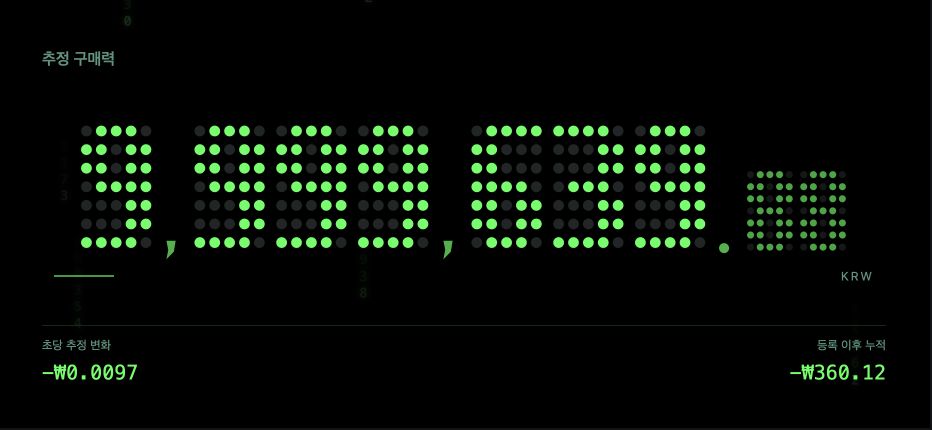
Why do moving numbers help?
Inflation and compounding are invisible, so explaining them in words alone can feel vague. Watching the same amount slowly shrink in one place and slowly grow in another makes it concrete that the value of money changes over time.
The goal is not to get the numbers right but to spark questions. Use the screen to talk together about why one number falls and why the other grows faster each year.
How different are money left alone and money earning interest?
The table below is an educational calculation assuming 2% inflation and 3% compound interest a year. Real prices and rates change every year, and these figures do not describe any particular account.
Money left alone stays at 100 but after ten years buys only about 82.03 worth at the original prices. Money earning 3% grows to about 134.39, and even after inflation it keeps about 110.25 of purchasing power.
| Period | Purchasing power of 100 left alone | Amount at 3% compound | Purchasing power of that amount |
|---|---|---|---|
| After 1 year | about 98.04 | 103.00 | about 100.98 |
| After 3 years | about 94.23 | about 109.27 | about 102.97 |
| After 5 years | about 90.57 | about 115.93 | about 105.00 |
| After 10 years | about 82.03 | about 134.39 | about 110.25 |
How do you show money left alone in DONNOK?
The My display board estimates purchasing power from the registration date. If you choose the day the money was received, you immediately see the value reduced by the rise in prices since then. The app calculates with Korea’s consumer price index whichever currency you choose, so outside Korea treat it as an illustration of the idea rather than your local prices.
- Open the My funds tab and tap Add fund.
- Choose Cash, then enter a name such as Birthday money and the amount.
- Set the registration date to the day the money was received.
- Tap Save and observe, then open the My display board in the Display tab.
- Turn the phone sideways for a large full-screen board.
How do you show money growing in DONNOK?
The My investment board assumes the principal grows by the annual return with yearly compounding and shows the expected amount every second from the moment you apply it. It is calculated separately from the funds in the My funds tab.
With a small amount the change per second is too small to notice, so if you want visible movement, try a larger pretend amount and explain that it is not real money. For the ten-year result, the table above or the future purchasing power calculator in the Settings tab is easier.
- In the Display tab, tap the board name (▼) at the top to open the list.
- Select My investment.
- Enter a principal and an annual return, for example 3.
- Tap Apply and start. The expected amount begins rising from that moment; applying again resets the starting point.
What questions can you ask together?
Rather than giving answers, let your child explain the reasons. These questions are examples to use while looking at the screen.
- If a snack that cost 1 last year costs 1.10 this year, can you still buy it with 1?
- The money hasn’t changed, so why is the number on the board going down?
- Why does the side with interest grow by more each year?
- What is good and what is missed if you spend the money now instead of saving it?
What should you know before showing it?
The numbers on the board are estimates based on assumptions, not a real account balance or real returns. Make sure to explain that money does not actually leave anywhere when the number falls.
DONNOK does not recommend any savings or investment product. The free version may show banner ads, so with young children an adult should hold the device. The app screens are in Korean and English; pair the board with financial education material suited to your child’s age.