 DONNOK
What is 1 million won from 1990 worth today? Converting old money with CPI
Using Korea’s CPI, 1 million won in August 1990 had the same purchasing power as about 3.09 million won in August 2026. A 1970–2016 table, the formula and how to see it in DONNOK.
How do you calculate the present value of old money?
The formula is old amount × today’s price index ÷ the price index at the time. A price index sets the price level of one reference period to 100 and compares other periods with it, so the ratio between two index values tells you how many times prices rose in between.
Korea’s index was 38.907 in August 1990 and 120.05 in August 2026. 1,000,000 × 120.05 ÷ 38.907 ≈ 3,085,563 won, so buying in August 2026 what 1 million won bought in August 1990 takes about 3.09 million won. Within the same index series, changing the base year leaves the ratio, and therefore the result, unchanged.
What is 1 million won from 1970 to 2016 worth today?
The older the money, the bigger the gap. 1 million won in August 1970 matches about 26 million won of purchasing power in August 2026, while 1 million won in August 2016 matches about 1.25 million won.
Prices also rose at different speeds. From August 1970 to August 1990 they rose by about 11.3% a year on average, and from August 2000 to August 2026 by about 2.5% a year. The average annual rate in the table runs from that year to August 2026.
| Then (August index) | Value in August 2026 | Price multiple | Average annual rise |
|---|---|---|---|
| 1970 (4.604) | about 26,075,152 won | about 26.1× | about 6.0% |
| 1980 (21.428) | about 5,602,483 won | about 5.60× | about 3.8% |
| 1990 (38.907) | about 3,085,563 won | about 3.09× | about 3.2% |
| 2000 (63.277) | about 1,897,214 won | about 1.90× | about 2.5% |
| 2010 (86.647) | about 1,385,507 won | about 1.39× | about 2.1% |
| 2016 (95.677) | about 1,254,743 won | about 1.25× | about 2.3% |
How does this work for a parent’s first salary or an old bank book?
If you know the amount and the date, the same formula works. A monthly salary of 700,000 won in August 1995 (52.302) gives 700,000 × 120.05 ÷ 52.302 ≈ 1,606,726 won, or about 1.6 million won of purchasing power in August 2026.
This moves the quantity of goods and services that money could buy into today’s money. It is a different question from how much wages have risen, so to judge whether a past salary was high or low by today’s standards you need to compare wage statistics separately.
How does it look on a DONNOK board?
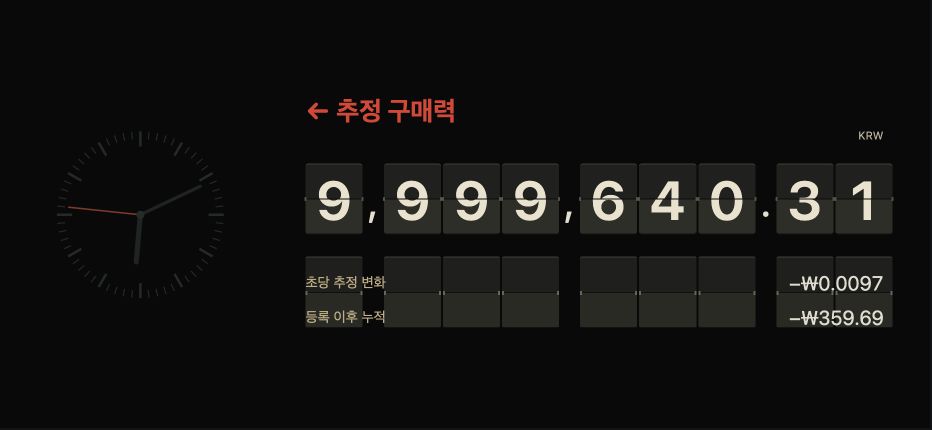
DONNOK shows the same calculation from the opposite direction. It assumes you have kept the amount unchanged since the registration date and displays estimated purchasing power = registered amount × index on the registration date ÷ current index. 1 million won registered in August 1990 shows as about 324,090 won, meaning that cash now buys only what about 324,090 won bought in 1990.
You can pick registration dates from 1 January 1970. The app estimates days between monthly index values and checks the latest public CPI when it runs, so its figure can differ slightly from the August monthly calculation here. The app always uses Korea’s CPI, whichever currency you select.
- Open the My funds tab and tap Add fund.
- Choose Cash or Other, then enter a name such as 1 million won in 1990 and the amount.
- In the registration date, scroll the year back to that time and pick the date.
- Tap Save and observe. The fund appears on the My display board in the Display tab.
- If it is only a comparison and not money you hold now, delete the fund afterwards so it does not mix into your total.
What should you keep in mind when converting old money?
A consumer price index bundles the prices of goods and services that households buy on average. Single items such as a bowl of noodles, a bus fare or tuition can change by a different multiple, and the purchase price of a home itself is not included in Korea’s consumer price index.
Over decades, what people buy and its quality also change a lot. This conversion is an educational way to gauge roughly how much everyday purchasing power the money had; it is not a measure of investment returns or asset values.