 DONNOK
South Korea’s national debt and M2 boards: how much do they grow per second?
How DONNOK estimates per-second growth of Korea’s national debt (1,304.5 trillion won in 2025) and M2 money supply, and why these are not live numbers.
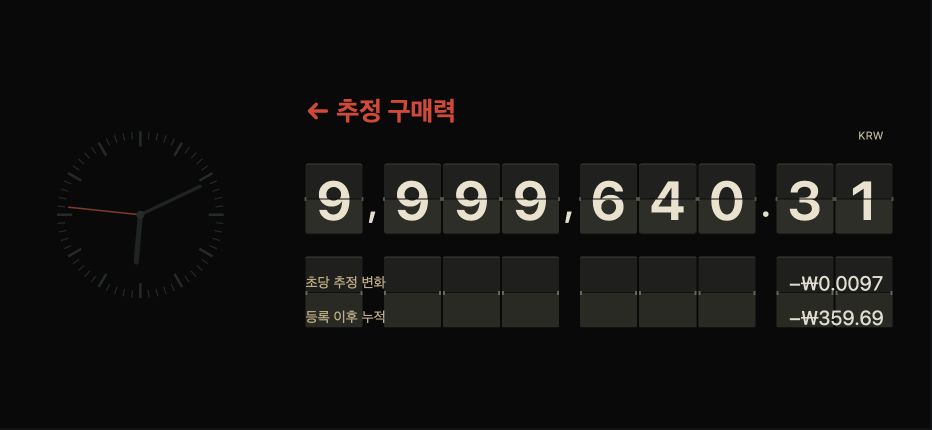
How is the national debt number set?
The board uses national debt D1: the combined debt of central and local government. It does not include wider measures that add public institutions, and it does not include household debt. At the end of 2025, D1 was 1,304.5 trillion won according to the national settlement.
The app assumes a constant increase over 365 days, from 1,304.5 trillion won at the end of December 2025 to 1,415.2 trillion won at the end of December 2026. That is 110.7 trillion won a year, or about 3,510,274 won per second. On this basis the board shows about 1,389.1 trillion won at midnight on 7 October 2026 (Korea time).
The 1,415.2 trillion won figure is a government forecast collected on 7 September 2026, not a final settlement. Forecasts for 2026 have been reported with slightly different values depending on the budget stage, such as 1,413.8 trillion won in the original budget; the final figure will come with the 2026 national settlement in 2027.
What does the money supply (M2) board show?
M2, or broad money, adds deposits that can be withdrawn at any time, money market funds and time deposits of less than two years to cash and demand deposits. The app uses the Bank of Korea’s M2 series measured as a monthly average and seasonally adjusted.
Starting from the latest release, 4,212.9554 trillion won for June 2026, the app assumes the same series’ growth over the previous year (from 3,975.3556 trillion won in June 2025), about 5.98%, continues. In early October 2026 that gives about 4,280 trillion won, rising by about 7.88 million won per second.
The Bank of Korea’s release reports year-on-year growth of 6.0% on the original (not seasonally adjusted) series, so decimals can differ. The board splits the number into Korean units of jo (trillion), eok (hundred million) and man (ten thousand) won.
Why are these estimates rather than live numbers?
National debt is settled once a year, and M2 is published monthly about two months later. Official statistics have no value for each day in between, so the app connects published values with a fixed rule and shows them second by second. The per-second increase is a calculated pace, not a count of real transactions.
Both boards currently use data collected on 7 September 2026 and estimate only through the end of 2026. After that, the numbers stop until the data is updated. Check the reference date and method shown under each board.
How do I show a national indicator board?
National indicators are separate from your funds, so there is nothing to enter. Your theme stays the same and only the content changes.
- In the Display tab, tap the board name (▼) at the top.
- Choose South Korea government debt or Money supply growth.
- Tap Fullscreen if you want to display it large.
What about the household debt and combined debt items?
The list also includes Household debt (Bank of Korea household credit) and Government + household debt. In app version 0.1.1 they are waiting for an official data connection and show no numbers, so that figures with different reference dates are never added together.
Do not read national debt as a per-person burden or as the country’s total debt. D1 is one range of government obligations; household and corporate debt and the assets the government holds are not part of this number.
Sources and related guidance
- Bank of Korea · Money and liquidity, June 2026 (checked 7 October 2026, Korean)
- Open Fiscal Data · National debt (checked 7 October 2026, Korean)
- The Korea Times · National debt of 1,304.5 trillion won in 2025 (6 April 2026)
- Financial News · 2027 budget proposal and national debt outlook (1 September 2026, Korean)
- DONNOK economic data and methodology