 DONNOK
Balance vs. purchasing power: what happens when prices rise?
Understand balance and purchasing power with a KRW 1 million example assuming 2% annual inflation, plus DONNOK’s Korean CPI and currency limits.
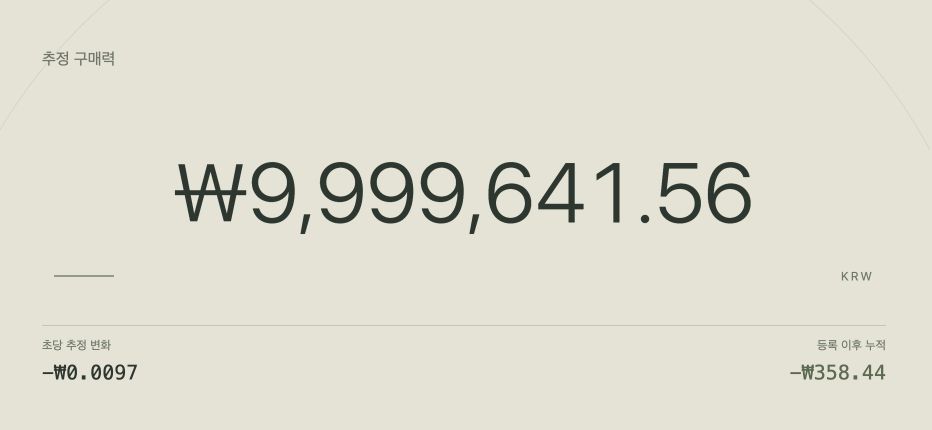
Why can purchasing power change while the balance stays the same?
With no deposits or withdrawals, KRW 1 million remains KRW 1 million. If goods and services become more expensive, that amount buys less. If prices fall, it may buy more.
CPI tracks price changes in a representative basket of consumer goods and services. Prices and spending habits vary, so an index will not precisely match everyone’s personal experience.
What can KRW 1 million buy after one year of 2% inflation?
Assuming the price level rises exactly 2% in one year, the amount’s purchasing power at earlier prices is 1,000,000 ÷ 1.02 ≈ KRW 980,392. The balance stays KRW 1 million, but it buys roughly what KRW 980,392 bought a year earlier.
The 2% rate is an explanatory assumption, not current inflation or a forecast. This simple example does not reproduce the app’s daily or second-by-second interpolation.
Which CPI and currencies does DONNOK use?
Personal displays estimate purchasing power using the fund’s registration date and South Korea’s CPI. You can record KRW, USD and JPY separately. Selecting a currency does not convert it or apply US or Japanese CPI.
The app checks whether Korean CPI needs updating at launch and on return to the foreground. Moving numbers represent calculations from data and assumptions, not new official statistics every second. New data may change the result.
How should I use this number?
Start by recording a fund and observing its estimated change. Check sources, reference dates and update status in the app’s economic data and methodology screen to understand the estimate.
The display is neither your actual bank balance nor a guaranteed return. This article explains purchasing power; it is not personalized investment advice.